Lesson 2: Me vs the world

Like many, I’m still recovering from childhood trauma. I can (now) genuinely say that I am thankful for my mother, my childhood, and my traumas. She did the best she could with the tools she had. She did a pretty-kick-ass job as a single mother in the 80’s from rural Mexico. After we migrated to the USA, it was just her and me, so the circumstances made me grow up fast, be highly independent, and fulfill many roles for my mother. Therefore, my needs and desires had to take a back seat. My coping mechanisms were to retreat into my metaphorical shell and shed or hide pieces of me to be what others needed. I’ve now realized I, like Christina Oh from Grey’s Anatomy, don’t have to contort myself to please others.

Cristina [Oh] has learned what she needs to know. Her toolbox is full. She has learned to not let go of the pieces of herself that she needs in order to be what someone else wants. She’s learned not to compromise. She’s learned not to settle. She’s learned, as difficult as it is, how to be her own sun.

Year of Yes by Shonda Rhimes


After being in my head for so looooooong (10 days is a long time, without a book, phone, internet, or the ability to communicate with other people), I finally understood why children develop imaginary friends. I am a grown-up, so I did the mature thing and adopted a spirit animal or what my culture would call an Alebrije. She is a unicorn named Matilda M. Zott, her “horn” doubles as a wand and microphone

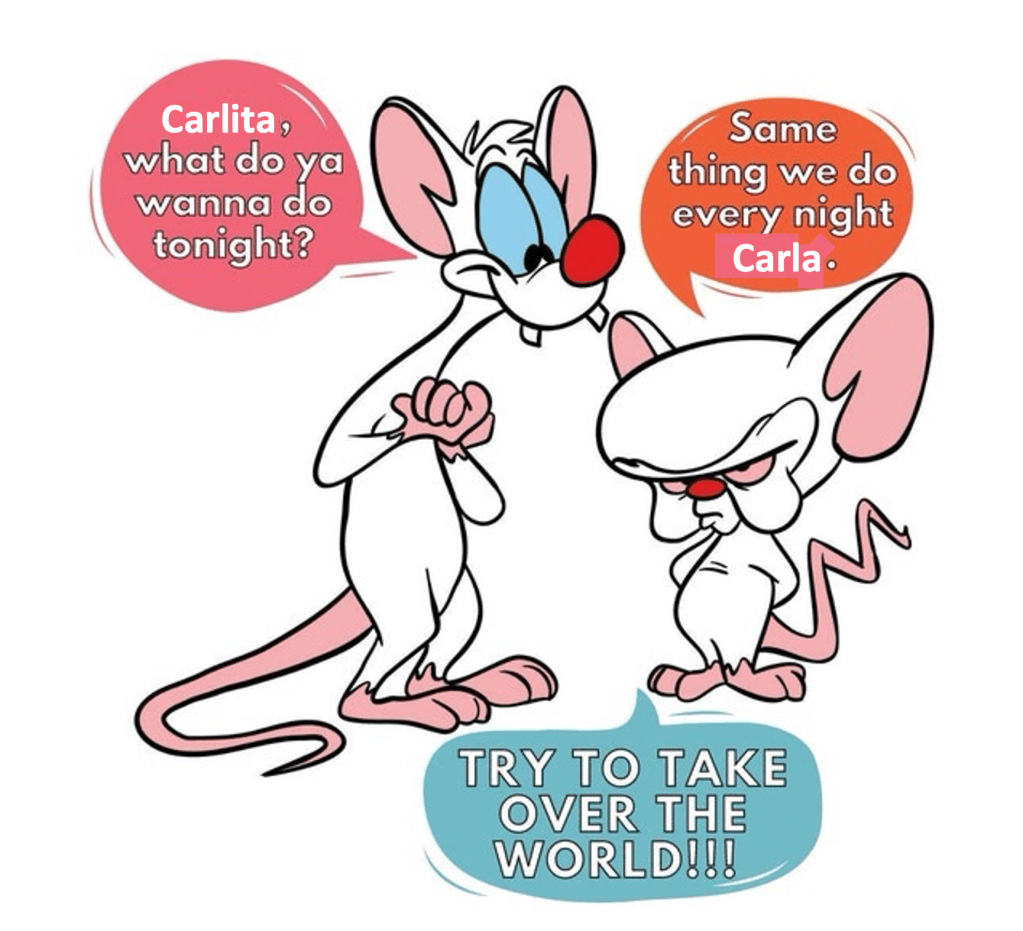
So now my inner child has Matilda and me to face the world with. So, really, we are quite an invincible trio. All this to say that I’ve never really been alone. Even when I lacked the tools or felt helpless, I always had me. So now my inner dialogue is similar to that of Pink and the brain…
Lesson 1: I control my thoughts and emotions

I am Latina; I grew up around telenovelas, full of passion, love, and Catholic guilt. Needless to say, emotions were front and center. So, the idea that I could control my thoughts and emotions was striking and incredibly empowering.

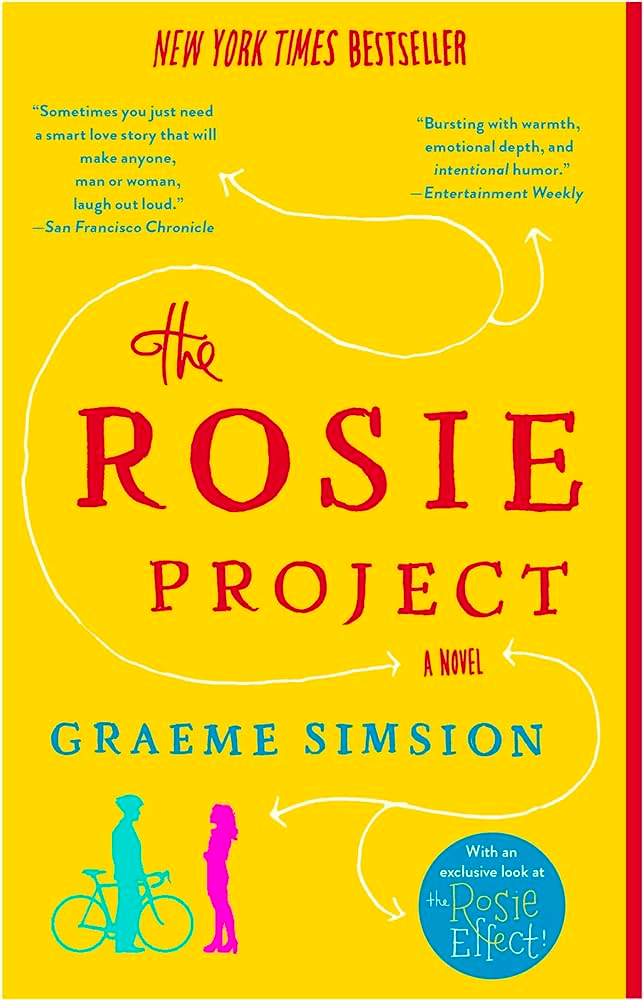
This is probably the reason why I was so enthralled by the protagonist, Don, in The Rosie Project. His world is devoid of human emotion and social filters, and thus has difficulty functioning properly in society. For example:

A woman at the rear of the room raised her hand. I was focused on the argument now and made a minor social error, which I quickly corrected.
“The fat woman—overweight woman—at the back?”
She paused and looked around the room, but then continued, “Rational detachment…”

The Rosie Project by Graeme Simsion

I cringe slightly at the interaction, but can you imagine a purely logical world? I’m pretty sure there are several setbacks, but it also seems profoundly liberating for a person who has been dominated by emotions her whole life (me).  

Now, though, I realize I can have the best of both worlds. I don’t have to be controlled by my thoughts or emotions; I can control them. Of course, it’s not like a switch has been turned off, BUT I now have the tools to control them.

An example of how this lesson works out in the real world. I grew up in Los Angeles, and diversity is part of my DNA. Since LA is a hodge-podge of immigrants, the “where you from” is unimportant. However, after over a decade of living in Taiwan, I used to get profoundly annoyed at the fact that even though I’ve made Taiwan my home for the past 10 years, I constantly get asked, “Where are you from?” It evokes inner turmoil and constantly reminds me that I don’t belong. My newfound tools have allowed me to respond in one of two ways

  1. I start to bombard them with facts about my beautiful country (we have delicious spicy food, our culture is very colorful, we love celebrating life, have you seen the movie Coco?) so that they can guess.
  2. I answer their questions and parrot their own questions back to them. It gets a bit awkward when they ask about salary (in my defense, they started it.)

However, both paths allow for a more in-depth interaction instead of the routine interview format. I also feel a bit more seen and not just labeled by my country of origin.

Vipassana 101

I guess before we really get to the “meat” of the content, I should explain Vipassana. It’s a meditation practice that, in Chinese 「內觀」, translates into looking within, which I think is pretty apt. You can look at the website here for more details.

It’s a 10-day residential course; upon entry, you hand over your phone, books, notebooks, and pens. You are also asked to sign an agreement in which you promise to abstain from

  • Killing
  • Stealing
  • Sexual activity
  • Intoxicants (alcohol, drugs, etc)
  • Lying *

Noble silence (no verbal or nonverbal communication) is also mandatory from the moment you sign the agreement. *It also facilitates the ability to abstain from lying. For example, if somebody asks you, “How are you?” You absentmindedly answer fine, without being fine. Voila, you’ve just lied.

The day starts at 4 a.m. and ends at 9:30 p.m. A total of 5.5 hours are allotted for meals, showering, and washing clothes; all the other time is spent meditating. Even when you are not meditating, there’s no way to escape your mind. Needless to say, I took a lot of naps the first couple of days.

Home is Within

A little over a decade ago, a friend’s cousin came to my house. I’m not sure how the topic came up, but the cousin said she was homeless, and I was baffled. She seemed “normal.” She appeared to have good hygiene and a positive demeanor. She didn’t seem like a druggie or fit any of the stereotypical Hollywood aspects of the typical homeless. In my inquisitive nature I wanted to understand more, here’s how the dialogue went.


Me: Where do you live?

“Homeless” cousin: in my body

Me: yeah, that’s cool, but what’s your address?

Tact was not my strong suit back then, and I remember not being satisfied with the answer. Now I get it, though. Sure, we may sleep in a bed, eat in a kitchen, and shower inside a “house,” but that’s our nest within the universe. We do the living part inside our body, our body is the temple that houses our mind, heart and soul. That’s where we live, think, and feel. This discovery has been quite empowering because I’ve always struggled with where I belong, I get to inhabit many cultures, but I never truly belong anywhere. Now, I realize that I always have a home within myself.

However, this understanding has taken quite a while, and it’s still a fairly new concept for me. Only in the last two years have I learned to be a friend to myself. My inner critic was an Olympian gold medalist commenting on my every move. It took years of therapy, a lot of introspection, endless self-help books/memoirs, and a Vipassana retreat in 2022 to finally dethrone that beast.

Now I can genuinely say that I like myself and dare I say love myself. One of the most life-changing realizations from my first-ever vipassana retreat was that “you can’t give what you don’t have.” I couldn’t give unconditional love if I didn’t have it for myself. Sure, I still have things that I would like to work on, but they don’t define me.

I’ve recently attended my second vipassana retreat, and the experience was much more serene since I wasn’t fighting my inner critic. The following will be posts dedicated to the many lessons I learned secluded from the world. It’s amazing what I could discover once I could fully be with myself.